 In the deep waters of Storsjön lives Storsjöodjuret, the lake monster—or so the legend goes. Reports of the snake-like creature with a dog’s head and dorsal fins date back to the seventeenth century. Persistent as they are, these reports still lack convincing evidence. Around 1890, an attempt was made to systematically search the entire lake and capture the beast, but it yielded nothing. In 1986, Storsjöodjuret even appeared on the list of endangered species, though serious naturalists apparently found that too far-fetched, and the monster has since been removed from the list. In 2008, there was renewed excitement over an underwater video showing a snake-like form in the water. Naturally, the footage was vague and open to many interpretations. Just like Nessie in Scotland, the myth of a possible monster generates more attention than any proof of its existence—or nonexistence. At the open-air museum Jamtli, an exhibition is dedicated to Storsjöodjuret.
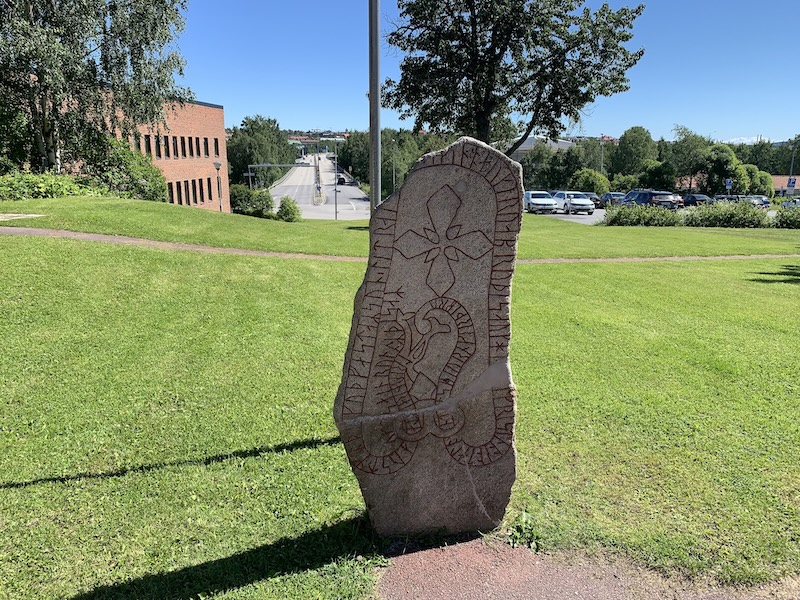
The monster was first mentioned in 1635, in the story of the trolls Jata and Kata, recorded by the minister Mogens Pedersen. The tale links the monster to the Frösö Runestone, which depicts a serpent-like figure with dragon-like coils, similar to many other runestones.
 Long, long ago, the trolls Jata and Kata stood on the shore of Lake Storsjön, each cooking something in their own cauldron. They stirred and boiled for days, weeks, and years, not knowing what their brew would become. One evening, a strange noise suddenly came from one of the cauldrons. It yelped, groaned, and screamed, followed by a loud bang.
From the cauldron leapt a strange creature: a black, snake-like body with a dog’s head. It disappeared into the lake, where it felt at home. It grew into an enormous monster, causing great fear among the people. Eventually, it wrapped itself around the island of Frösön and was able to bite its own tail.
The troll Ketil Runske used a powerful spell to control the monster and keep it safely in the lake. This spell was carved into a stone, which was placed on Frösön. The serpent was depicted on the stone. In this way, the monster remains trapped—until someone one day can read and understand the inscription.
A song about the monster:

