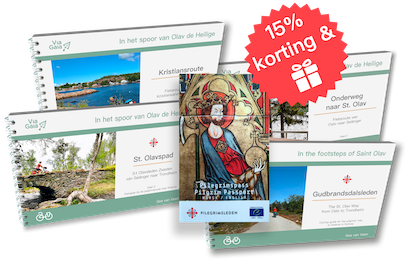
Trondheim is a nice city to arrive in after a long pilgrimage. The compact centre embraced by the Nidelva has enough to offer a pilgrim in transition, getting used to the status of being an ordinary human being again. A number of tips are in the cycling guide Gudbrandsdalsleden (page 170) and they are listed below on this web page. If you click on the name, you will find the address and a link to the website with opening hours and other useful information.
But... Trondheim has much more to offer, especially for pilgrims! On the website of Pilegrimsleden you will find a lot of nice tips for:
Tip
Visit the pilgrim reception at Nidaros Pilegrimsgård first. Pilgrims get a golden ticket in their pilgrim passport, which gives them free entrance to the cathedral and discounts at various museums, places to eat, boat tickets, guided tours and a lot more.
Via Gaia tip
Baklandet Skydsstation. A very nice café where you can enjoy delicious food and drinks in a traditional setting. The words Genuine, tasty & idyllic on their website are not exaggerated. Pilgrims will get discount on presentation of their pilgrim pass.
Nidaros Cathedral is the largest Gothic church in Scandinavia and the most important church in Norway. You have to pay a fee to visit the church, but pilgrims get in for free. Visit the pilgrim reception at Nidaros Pilegrimsgård first. Pilgrims get a golden ticket in their pilgrim passport, which gives them free entrance to the cathedral.
Kongsgårdsgata 2, 7013 Trondheim
Tel. +47 73 89 08 00
Info: Nidarosdomen.no (The website is only in Norwegian. Here you can read about the church in English):
St. Olav’s grave
Olav II died in the Battle of Stiklestad in 1030 and was buried on the bank of the river Nidelva. Olav Kyrre had a chapel built over the grave. Next to the chapel a spring rose which produced healing water. More and more miracles were reported, and King Olav II was canonized in 1031. In 1066 Olav Kyrre ordered a new Christian church to be built on the chapel’s location where his canonized uncle would be given a proper resting place in a silver shrine.
Place of pilgrimage
Nidaros became a place of pilgrimage. When the canonization received pontifical recognition in 1164, the number of pilgrims began to grow, and Nidaros became one of the most important pilgrim destinations. The pilgrims worshipped the shrine, drank from the healing holy water, and took some of it home in special jugs. The stone casing of the (now dry) spring can be found in the sanctuary of the church. To avoid spillage, the holy water was ingenuously collected so that it could flow back to the spring. The greasy black stains on the stones is caused by the innumerable hands that touched them. Nearby an example of a pilgrim jug can be found. Today, the fountain near Hadrians plass, close to the Elgeseterbru, is called a St. Olav’s spring, but the water is municipal drinking water.
Remelted shrine
During the Reformation the Danish transported the church treasures, including St. Olav’s silver shrine, to Denmark where they were melted down. The wooden chest with the body’s remains was placed in a stone grave, which was covered with soil. No-one knows for sure where this was done, probably somewhere near the sanctuary. The exact location was deliberately not indicated for the Protestants hoped the saint would soon be forgotten soon, or so the story goes…
Building and burning
The cathedral from the 11th century by no means resembled the building we see today. The church started in the simple Roman style and changed considerably over the next centuries due to extensions, alterations, multiple big fires, periods of decline, and rebuilding. The octagonal sanctuary and the choir aisle where the sanctuary and the shrine were located, is the oldest existing part of the church. In the last 150 years the church has been restored extensively. The glorious west front, of which only a small original part has survived, was not completed until 1969. The large statue gallery consists of sculptures of martyrs, kings, apostles, and saints. Apart from Olav II, these include St. James (of Santiago de Compostela) and Saint Birgitta of Sweden (1303-1373), who made pilgrimages to Nidaros, Santiago, Jerusalem, and Rome, and who is the patron saint of pilgrims.
Norwegian natural- and cultural history
The University Museum is a treasure trove of exciting stories from Central Norway’s natural and cultural history and they offer several exhibitions about people and animals – in the past, present and future. They offer both spectacular archeological finds and deep dives into the magical world of nature adapted for both adults and children. They accommodate two houses on Kalvskinnet in the middle of Trondheim city center- Suhmhuset and Gunnerus – Ringve botanical garden.
Erling Skakkes gate 47B, 7012 Trondheim
Tel. +47 73 59 21 60
Info: ntnu.edu/museum
The largest wooden house in Norway is located in the middle of the centre, and it's Trondheim’s official royal residence. It was built between 1774 and 1778 for the rich widow Cecilie Christine Schøller. Every summer, the palace’s grand halls and rooms open to visitors. Together with a skilled guide, you can become more familiar with a major work in Norwegian architectural history and the Norwegian monarchy. There are several tours every day during summer.
Munkegata 23, 7011 Trondheim
Tel: +47 90 23 52 94
Info: nkim.no/stiftsgarden
20% discount for pilgrims.
A museum about the maritime history of Trondheim and its surrounding region. The museum is hosted in one of Trondheim’s oldest brick houses - a former guardhouse from the 18th century.
Kjøpmannsgata 75, 7010 Trondheim
Tel: +47 73 52 89 75
Info: trondheimsjofart.no
20% discount for pilgrims.
Right outside the city centre of Trondheim you find this historical oasis, and one of Trondheims largest outdoors park areas. The folk museum in Trondheim is built around the ruins of King Sverre’s castle Sion, which date as far back as 1183. This open air museum is the third largest in Norway.
Sverresborg Allé 13, 7020 Trondheim
Tel: +47 73 89 01 00
Info: sverresborg.no
Along with the Nidaros Cathedral, the Archbishop’s Palace has a unique place in Norwegian history. It was the archbishop’s residence until the Reformation, and now one of Trondheim’s most fascinating museums with archaeological finds from the Archbishop’s Palace. You will find the Archbishop’s Palace next to Nidaros Cathedral.
Kongsgårdsgata 2, 7013 Trondheim
Tel: +47 73 89 08 00
Info: nidarosdomen.no (The website is only in Norwegian. Here you can read about the church in English):
The Archbishop's Palace in Trondheim (Norwegian: Erkebispegården i Trondheim) is a castle and palace in the city of Trondheim, located just south of the Nidaros Cathedral. For hundreds of years, the castle was the seat, residence and administrative centre of the Archbishop of Nidaros.
During the Middle Ages
The castle is one of the largest medieval stone structures in Scandinavia, and the oldest walls are likely from the 13th century. The Archbishops of Nidaros expanded the castle gradually, with great halls and residential areas being built over time. Norway's last Archbishop, Olav Engelbrektsson, attempted to make a final stand and defend the castle during the Reformation, but eventually fled into exile.
Royal property
After the abolishment of Roman Catholicism, the castle became royal property, where the local lensherre (Lord of the manor) resided. The castle was restored, rebuilt into a residential palace and eventually used more for military purposes, again being expanded considerably. After the Sovereignty Act of 1660, the castle became the seat and residence of the Amtmann.Restoration and current use
Substantial archaeological excavations were made during the 1950s by Nicolay Nicolaysen and Gerhard Fischer which led to restorations being made at the castle. Today, the castle has several museums, is frequently used by the Church of Norway and is also the venue of Olavsfestdagene.
15% discount for pilgrims (boat and guide tour)
Munkholmen was Trondheim’s trial in the Viking Age. Just after the year 1000, a Benedictine monastery was built on the islet, probably one of the first two in the Nordic countries. In 1658 the monastery was converted into a fortress and a prison, and later also to a customs station. Today, the islet is a popular spot with a sandy beach in the period May – September.
Boat across to Munkholmen goes from Ravnkloa which is at the end of Munkegata in the middle of Trondheim city center.
A charming neighbourhood cobbled with history and filled with nice restaurants, bars and store fronts.
On the website of Visit Trondheim you will find all the restaurants, galleries and shops in Bakklandet.
Free entrance
There is an article written on this website about the fortress: Kristiansten Festning.
20% discount for pilgrims.
Kjøpmannsgata Ung Kunst, K-U-K